
Frozen Details — Why Winter Is Asking You to Slow Down
There's a moment — and you've probably felt it without ever naming it — where you're walking outside in the dead of winter and something stops you. Not something loud. Not something dramatic. It's the opposite, actually. It's quiet. It's small. It's a little patch of frost on a fence post, or the way ice has crept across a puddle overnight in a pattern that looks like it was hand-drawn. And for just a second, you forget you were in a hurry.
That moment is where this week's prompt lives.
This Monday, we're slowing down. We're getting close. And we're looking at winter the way it actually wants to be seen.
The Prompt
"Frozen Details"
Capture a winter close-up that reveals what the season hides in plain sight.
That's it. That's the whole assignment. But let's talk about what it actually means — because there's a lot more happening in those two sentences than you might think at first glance.
Why I Chose This One
I'll be honest with you. I've been sitting on this idea for a while. I kept circling back to it every time the weather turned, and I kept putting it off because I wasn't sure it would land the way I wanted it to. Photography prompts are easy to write. Creative prompts that actually make you feel something before you even pick up your camera? That's harder.
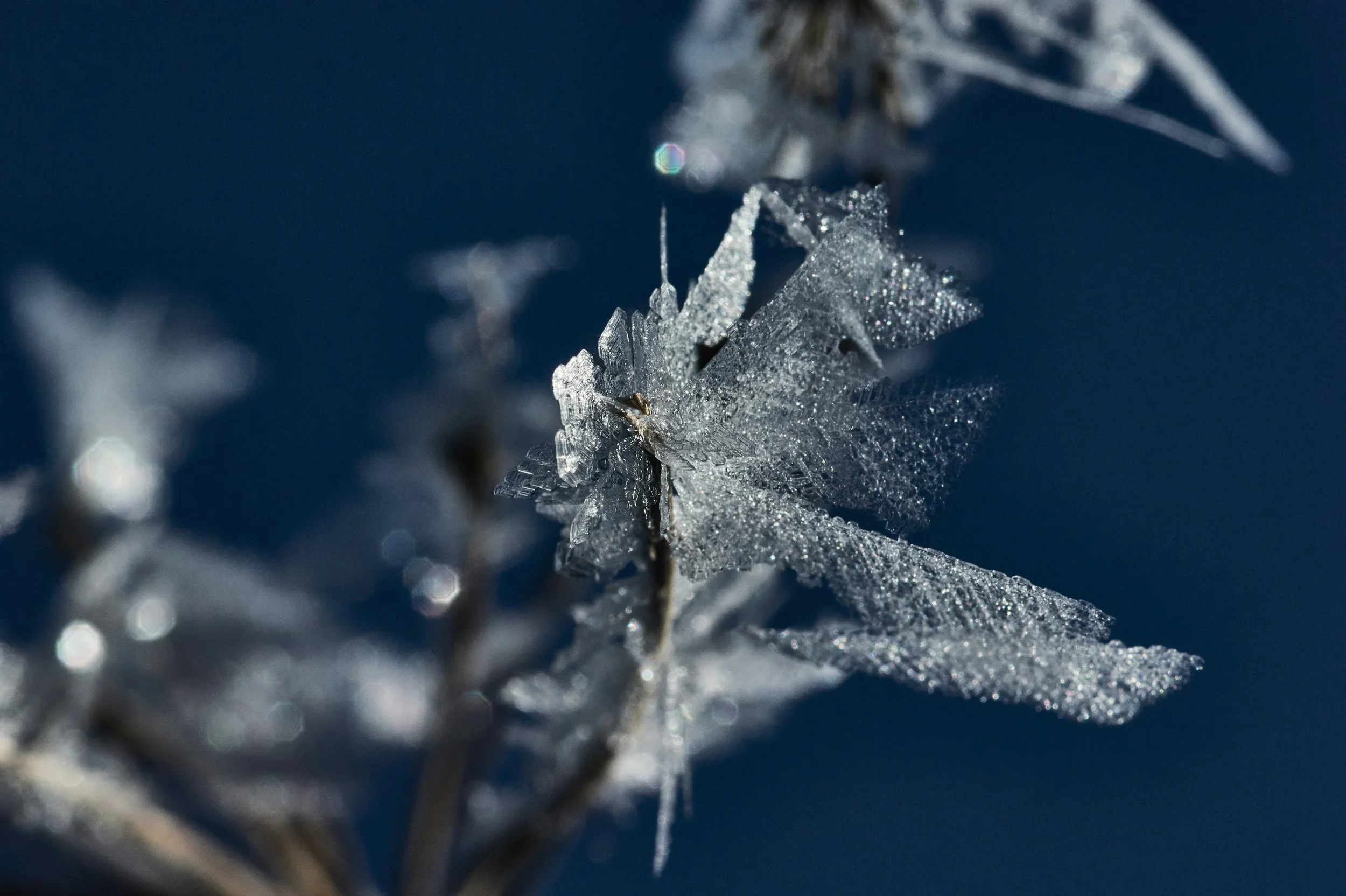
But then we had our winter storms roll through here, and one morning I found myself outside staring at a dead plant stem that had been completely transformed overnight. The frost had built these incredible crystalline structures all along the edges, like tiny glass sculptures growing out of nothing. And I thought, this is it. This is the one. I even tracked down a reference shot that nailed exactly what I was picturing — and that's the image you'll see with this prompt.
Because here's the thing about winter that most of us walk right past: it's not actually a season of absence. We talk about it like that all the time — everything is "gone," everything is "bare," everything is "dead." But if you actually get down low and get close, winter is incredibly busy. It's just working on a scale we're not used to looking at.
Frost doesn't just appear. It builds. Crystal by crystal, layer by layer, in patterns that follow the laws of physics but look like art. Ice doesn't just cover a surface — it carves it, reshapes it, turns a plain rock into something that looks like it belongs in a museum. Snow doesn't just fall — it settles, it compresses, it catches light in ways that make you question whether you're looking at something natural or something someone spent hours creating by hand.
Winter is doing all of this work, and most of us just zip up our jackets and rush past it.
This prompt is an invitation to stop. To actually look. And to bring your camera along when you do.
What "Frozen Details" Actually Means
Let me break this down a little, because I want to make sure we're all working from the same place — not because there's a "right" way to shoot this, but because understanding the intention behind the prompt will help you find your version of it.
The word "frozen" is doing double duty here. On the surface, it's literal — we're talking about frost, ice, snow, frozen textures. The stuff that shows up when temperatures drop and moisture meets cold surfaces. But "frozen" also speaks to something about the feeling of winter. That stillness. That hush. The way a cold morning feels like the whole world just hit pause.
"Details" is where it gets interesting. This isn't a landscape prompt. This isn't about sweeping vistas or dramatic mountain shots dusted in snow. This is about the small stuff. The stuff you'd miss if you were walking at a normal pace. A frost crystal the size of your thumbnail. The edge of a leaf where ice has just started to take hold. The way snow settles in the curve of a dried-out seed pod.
Your subject should feel fragile. It should feel temporary. Because it is. One shift in temperature, one ray of afternoon sun, and it's gone. That impermanence is part of what makes it beautiful — and part of what makes photographing it feel urgent in the best possible way.
The Reference Shot
I want to talk about the reference image I've included with this prompt, because it's a perfect example of exactly what I'm looking for — and studying it might help you find your own angle.
What you're looking at is a macro shot of frost crystals that have formed along the stem of a dried plant. The frost has built up in these jagged, almost architectural layers — like tiny shards of glass that have been stacked and arranged by some invisible hand. The photographer used a shallow depth of field, which means the subject is sharp and crisp right in the center while the background fades into this gorgeous, dark, blurred wash of blue.
Notice how there's almost no "context" in the image. You can't really tell what the original plant was. You can't tell where this was taken or what season it technically is, even though the answer is obviously winter. The frost has transformed the subject so completely that it becomes something else entirely. Something almost sculptural. Something that doesn't look like it belongs in the natural world at all.
That's the goal. Not to document what winter looks like from the outside, but to reveal what it's doing up close — and to let that transformation be the story.
Also notice the light. It's natural, soft, and cool-toned. There's a subtle sparkle to the crystals — not flashy, not blown out, just there. The kind of light that makes you lean in closer to look. That's the vibe we're going for.
How to Actually Shoot This
Okay, so now you're probably thinking: great, but how do I actually do this? Fair question. Let me walk you through some practical stuff that'll help you get into the zone.
Get close. Closer than you think you need to. This is a macro prompt, or at the very least a tight-crop prompt. If you're shooting with a phone, use the portrait mode or the dedicated macro setting if your phone has one. If you're shooting with a camera, a macro lens is ideal, but you can also get surprisingly close with a kit lens if you're patient. The closer you get, the more the frost and ice textures become the entire frame — and that's exactly where the magic lives.
Use shallow depth of field. You want your subject sharp and your background soft. On a phone, portrait mode handles this for you. On a camera, open up your aperture (lower f-number) and get as close to your subject as your lens will allow while still keeping it in focus. A tripod or a steady surface will help enormously here, because at these close distances, even a small shake can throw your focus.
Let the texture be the star. You don't need a "pretty" composition in the traditional sense. You need a compelling one. And at this scale, what makes a composition compelling is texture — the way the crystals catch the light, the patterns in the ice, the contrast between a rough frozen surface and a smooth one. Trust the details to carry the image. You don't need to make it "look like" anything. You just need to make it feel like something.
Keep it simple in the background. A cluttered background will fight with your subject for attention, and at this scale, that fight is one you'll always lose. Look for angles where the background is a single, neutral tone — dark sky, shadowed ground, a plain wall. The reference image uses a deep, dark blue background, and it works beautifully because it lets every single crystal in the foreground demand your attention.
Shoot in the golden hours, or on an overcast day. Direct midday sun can be too harsh for this kind of work — it'll blow out the highlights on the frost and make the crystals look flat. Early morning light (right after sunrise) is gorgeous for this because it's soft, directional, and cool-toned. Overcast days work well too, because the light is even and diffused, which brings out the texture without creating harsh shadows. And obviously, shoot before the sun warms things up too much, or your frost will be gone before you get the shot.
Natural light only. I know flash can be tempting when you're shooting small subjects, but for this prompt, it's going to fight you. Flash tends to flatten frost and ice, and it introduces a warmth that works against the cool, quiet mood we're going for. Stick with what the sky gives you.
The Deeper Thing This Prompt Is About
Here's where I want to get a little more honest with you about why I wrote this prompt the way I did.
We live in a world that constantly tells us to look at the big picture. Zoom out. See the whole thing. Get the wide shot. And there's nothing wrong with that — sometimes you need the perspective that only distance can give you. But somewhere along the way, a lot of us lost the habit of looking closely. Of noticing the small stuff. Of letting something tiny and quiet earn our attention for more than a passing glance.
Photography has a way of forcing that. When you're trying to capture a frost crystal — something that might be a quarter of an inch across — you have to be present in a way that most of our daily lives don't require. You have to be patient. You have to be still. You have to actually look at what's in front of you instead of scrolling past it.
And honestly? That's one of the reasons I do these prompts every Monday. Not because I think everyone needs to become a professional photographer. Not because I think creative work is the most important thing in the world. But because the act of looking for something to photograph — really looking, with intention and curiosity — changes how you move through your day. It makes you notice things. It slows you down. It gives your brain a break from the noise.
This prompt is one of the quieter ones I've written. It's not going to get a ton of likes on social media. It's not going to show off your gear or your technical skills or your editing prowess. It's just going to ask you to pay attention to something small and fleeting and beautiful, and to see if you can capture even a fraction of what made you stop and look in the first place.
And I think that's worth doing.
A Few Things to Keep in Mind Before You Shoot
Winter mornings are cold. Like, actually cold. If you're heading out early to catch that frost before it melts, dress warm, protect your hands, and give yourself permission to spend more time outside than you planned. Some of the best shots happen when you stop rushing and just sit with your subject for a while.
Also — and this is important — don't wait for perfect conditions. You don't need a specific kind of storm or a particular temperature or a magical alignment of light and weather. Frost shows up on almost any cold morning. Ice forms on almost any surface that holds water. If it's cold where you are and there's been any moisture at all, you've got material to work with. The prompt isn't asking you to find something rare. It's asking you to look at something common in a new way.
And if you're feeling stuck on what to actually photograph, here are a few starting points to get your eye moving: look at windows in the early morning, fence posts and railings after a cold night, any kind of dried plant or seed head that's been sitting outside, the edges of puddles or birdbaths, or even the surface of your car on a frosty morning. There's frozen detail everywhere once you start looking for it.
Share What You See
If you shoot this prompt — or if something about it inspires you to go looking for frozen details on your own — I'd genuinely love to see what you find. Drop it in the comments, tag me, send it my way however feels right. These prompts are more fun when they're a conversation, not just a one-way assignment.
And if you haven't been following along with the Monday prompts yet, this is as good a week as any to start. You don't need to catch up. You don't need to have done the previous ones. Just pick up wherever you are and give it a try. There's no grade. There's no deadline beyond "before next Monday." There's just you, your camera (or your phone, seriously, it's fine), and a reason to go outside and actually pay attention to the world for a little while.
That's the prompt. Go find your frozen details. And hey — if you want to get these prompts delivered straight to your inbox every Monday so you never miss one, you can sign up for my newsletter. It's free, it's short, and it's the only email I promise won't waste your time.
Photo by Wolfgang Hasselmann on Unsplash