
Monday Prompt: Dormant Energy — What February Knows About Waiting for Spring
There's something I've been thinking about a lot lately — and maybe it's because we're deep in February, that strange month that sits right between the dead of winter and the first whispers of spring. We equate creativity with constant output, like the only valid artistic state is full bloom, leaves unfurling, color everywhere. But what about right now? What about these quiet weeks when nothing visible is happening, but something important is still at work beneath the surface?
February knows something the rest of the year forgets: dormancy isn't emptiness. It's preparation. It's the seed under snow, the bulb under frozen ground, the tree that looks dead but is actually gathering strength for what comes next.
That's where this week's prompt lives. In the space between what was and what's coming. In the dormant energy of late winter, when spring isn't here yet but you can almost feel it waiting in the wings.
And this week, I'm not just giving you the prompt and wishing you luck. I'm going first. I made the thing I'm asking you to make, and I'm sharing it with you right here so you can see exactly what I mean — not because mine is "the right way," but because sometimes it helps to see someone else take the first step before you're willing to take yours.
The Prompt
Theme: Dormant Energy
Medium: Collage
Your assignment this week is to create a collage that captures the feeling of potential, rest, and quiet transformation. Not growth — dormant energy. The kind that sits beneath frozen ground or inside a seed coat in late February, waiting for the right conditions to wake up.
This isn't about spring. Not yet. This is about the pause right before spring. The in-between. This is about honoring February's particular brand of stillness — the kind that looks like nothing but is actually everything. The kind that knows something is coming, even if it can't prove it yet.
Why Collage? Why This, Why February?
Here's the thing about collage: it's forgiving in a way that other creative mediums aren't. You don't need to be "good at drawing." You don't need expensive tools or a dedicated studio space. You just need scissors, glue, some paper, and a willingness to play.
But here's the other thing about collage, and why it feels especially right for February: it's about bringing disparate pieces together into something new. It's about transformation through patience and arrangement. And that's exactly what this month is doing in the natural world right now. Beneath the cold, beneath the gray skies, beneath the feeling that winter will never end — things are already starting to shift. Bulbs are waking up underground. Buds are forming on branches. The light is changing, even if you haven't noticed it yet.
February is dormant energy personified. It's the pause before the crescendo. And making art about that — about the tension between stillness and the spring that's coming — feels like exactly the right creative work for right now.
And if you've been out of creative practice for a while — if it's been months or even years since you made something just for the sake of making it — collage is one of the gentlest ways back in. There's no blank canvas staring you down. There's no pressure to come up with an original idea from scratch. You're just arranging things that already exist into something new.
It's also fast. You can finish a collage in an hour. You can finish one in twenty minutes if you're working intuitively and not overthinking it. And in a world where most creative projects feel like they require weeks of commitment before you see any results, that speed is a gift. You get to complete something. You get to see it exist. And that act of completion — even if it's small, even if no one else ever sees it — reminds you that you're still capable of making things.
So that's why collage. And that's why now.
I Went First (And Here's What I Made)
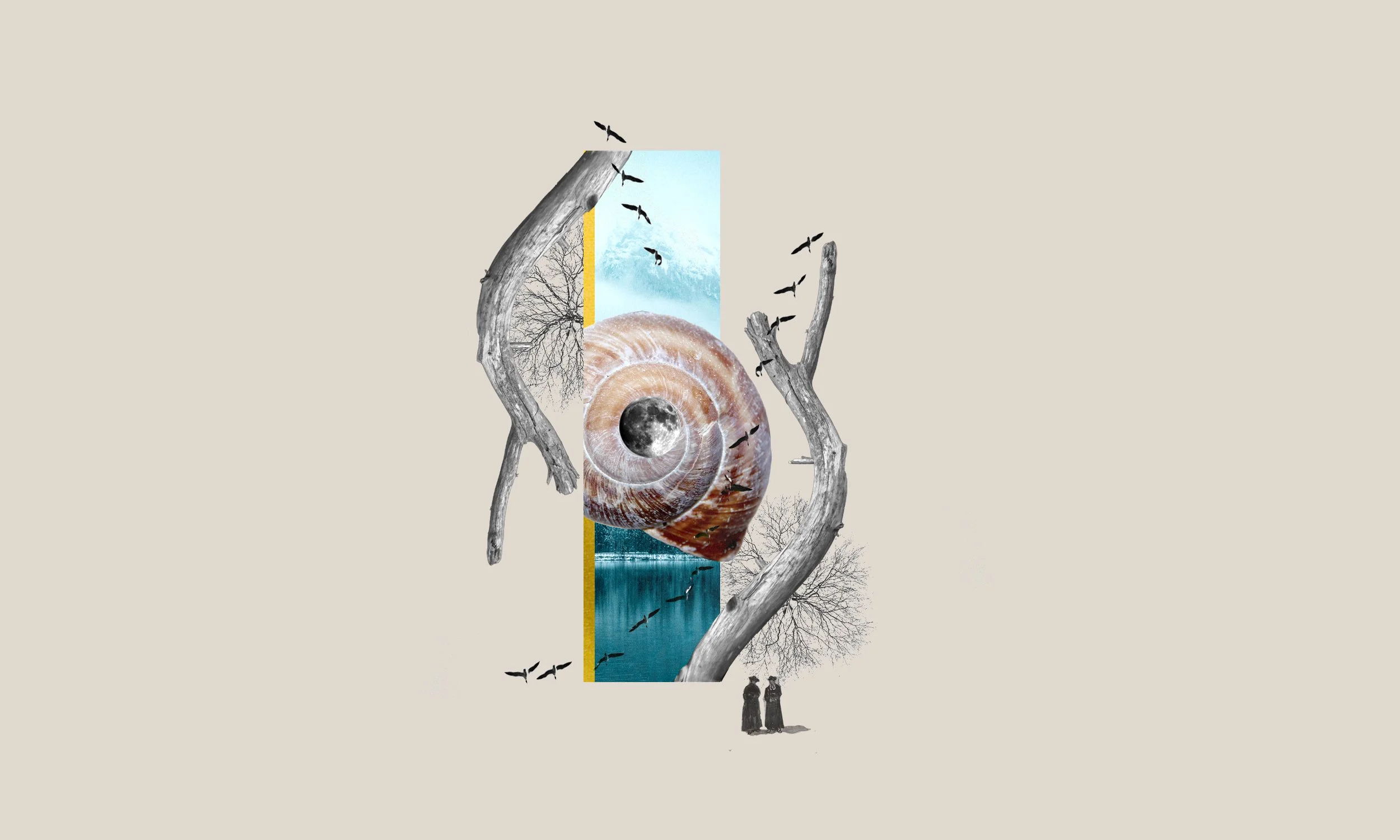
I'm including an image of my collage with this post because I want you to see what "dormant energy" can look like when you translate it into paper and glue.
What you're looking at is a composition built around natural, organic forms — bare branches, a nautilus shell, birds in flight, two small figures at the bottom, and rectangular photo fragments of sky and water layered throughout. The palette is muted: grays, soft blues, a hint of warmth in the shell. The background is neutral beige, almost like aged paper.
The branches are skeletal, leafless, reaching upward but going nowhere. The shell is spiraled inward, a form that's all about containment and slow, iterative growth over time. The birds are moving, but they're small, almost shadows. The figures at the bottom are standing still, looking up or out — witnessing, not acting. And those rectangular photo fragments? They're windows. Portals. Little reminders that even in dormancy, there's sky. There's water. There's a world still turning, even if you're not.
I didn't plan this collage ahead of time. I started with the branch images because they felt right for the theme, and then I just kept adding elements until the composition felt balanced. The shell came in because it's one of nature's best examples of patient, incremental building — something that happens so slowly you'd never notice it in real time, but the result is undeniable. The birds were a late addition, and I almost didn't include them, but they added just enough movement to keep the piece from feeling too static.
Here's what I want you to notice: the collage doesn't explain itself. It doesn't spell out "this is about dormant energy" in literal terms. It just feels like it. And that's the goal. You're not illustrating a concept. You're evoking a mood.
The Ingredients: What to Look For
Let me walk you through some of the elements I suggested in the original prompt brainstorm, because I want to give you a clear starting point even if you end up going in a completely different direction.
Natural Elements — Think Potential, Not Growth
A single bare branch. Thin, slightly crooked, reaching but not arriving. This is the backbone of dormant energy. It's alive, but it's waiting. You can find images of bare branches everywhere — old botanical illustrations, black-and-white photography, even your own backyard if you want to photograph one yourself and print it out.
A twig shadow instead of the twig itself. I love this idea because it's even more abstract. It's the implication of the form, not the form itself. Shadows suggest presence without requiring the thing to actually be there. Very on-theme for dormancy.
One seed. Sunflower, acorn, maple, even just a generic oval. Seeds are the ultimate dormant energy — they're packed with everything they need to become something massive, but right now they're just sitting there, small and unassuming. A single seed in your composition can anchor the whole thing.
Soil clump with negative space around it. I didn't use this in my piece, but I almost did. There's something beautiful about showing dirt — not as mess, but as the medium where all this waiting happens. And giving it space around it, isolating it, makes it feel important.
Pressed leaf fragment. Not a whole leaf. A torn edge. Just a piece of something that used to be full and green and alive. Now it's dry, it's fragile, and it's still here. That's dormancy too.
Dried grass stem, almost disappearing. Emphasis on "almost." You want it faint, you want it delicate, you want the viewer to have to look twice to see it. Let the composition breathe. Let things fade.
The Big Tip: Crop Aggressively
This is important, so I'm pulling it out into its own section. When you're selecting images to cut out and use in your collage, don't feel like you have to include the whole thing. In fact, you usually shouldn't.
Crop a branch so you only see part of it. Crop a shell so the spiral is cut off mid-curve. Crop a bird so you see wings but not the head. Let the viewer's brain finish the form. That incompleteness is what makes collage feel dynamic instead of static. It invites the eye to move. It creates tension. And tension, even in a piece about stillness, is what keeps people looking.
How to Actually Make This Thing
Okay, enough theory. Let's talk about the actual process, because I know some of you are reading this and thinking, "Cool idea, but I have no idea where to start."
Step 1: Gather your materials.
You need: scissors or an X-Acto knife, a glue stick or matte medium, a base (heavy paper, cardstock, or even an old book page if you want texture), and a pile of source images. You can pull images from old magazines, printed photos, botanical books, free stock photo sites, your own photo library — anywhere. I like to print things out on regular printer paper because it's easy to cut and layer.
Step 2: Cut without a plan.
I'm serious. Don't sit down with a sketch and try to execute a vision. Just start cutting out things that feel right for the theme. Branches. Seeds. Textures. Neutral tones. Let your hands lead for a while. You'll end up with a little pile of elements, and that's when the actual composing starts.
Step 3: Arrange before you glue.
Lay things out. Move them around. Try the branch on the left, then the right, then diagonal. Put the seed in the center, then in the corner. There's no right answer here, but there are arrangements that feel more balanced than others, and you'll know it when you see it. Trust your gut.
Step 4: Glue it down and stop second-guessing.
Once it feels right, commit. Glue it. Done. Don't keep tweaking. Don't keep adding. One of the best things about working in collage is learning when to stop, and that's a skill that transfers to every other creative thing you'll ever do.
Step 5: Photograph it and move on.
Take a picture of your finished piece with your phone. That's your documentation. Now it exists in the world, and you can share it or keep it private, but either way, you made something. That matters.
What This Prompt Is Really About
Let me be honest with you for a second. This prompt isn't actually about collage. I mean, it is — you're going to make a collage, and that's great — but the real reason I'm asking you to do this is because February has a way of making a lot of us feel stuck.
Stuck in the winter doldrums. Stuck in creative ruts. Stuck in the feeling that if you're not producing constantly, if you're not "growing" and "achieving" and "moving forward," then you're somehow failing. And February, with its short days and cold mornings and general sense of "is this ever going to end?" can amplify all of that.
But here's what I want to offer you: dormancy isn't failure. Dormancy is strategy. It's how organisms survive conditions that would otherwise kill them. It's how seeds make it through winter. It's how trees conserve energy so they can explode into life when the time is right.
And February? February is the master class in dormant energy. It's the month that sits in the tension between winter and spring, holding both at once. Nothing looks like it's happening. But everything is happening. Underground, inside bark, beneath frozen soil — the work of spring is already underway. You just can't see it yet.
If you've been feeling like you're in a fallow period, like nothing's happening and you've lost your edge, maybe you're not stuck. Maybe you're just in your February. Maybe your creative energy is doing important work beneath the surface, and it just hasn't shown itself yet. Maybe spring is coming, and you're right on schedule.
And making a collage about that — about honoring the pause, about sitting with the stillness instead of fighting it — is a way of giving yourself permission to be exactly where you are. Not where you think you should be. Where you are.
That's the real assignment.
A Quick Note on "Going First"
I mentioned this at the top, but I want to come back to it because it's important. I don't usually share my own work with these prompts. I usually just give you the assignment and let you run with it. But this week felt different.
This week, I wanted you to see that I'm doing this too. That I'm not just throwing prompts at you from some elevated creative high ground where everything comes easy and I never struggle. I'm in the same place you are. I'm trying to stay consistent. I'm trying to keep making things even when it feels pointless or small or like no one's paying attention.
And showing you my collage — even though it's imperfect, even though I could pick it apart and tell you everything I'd do differently if I made it again — is my way of saying: it's okay to make things that aren't perfect. It's okay to share things that are just "good enough." The point is to make them. The point is to keep your hands moving.
So if sharing your work feels scary, or if you're worried it won't be good enough, remember: I went first. And I'm not a collage expert. I'm just someone who showed up on a Monday morning, cut some paper, and glued it down. You can do that too.
Share Your Work (Seriously, Please Do)
If you make a collage for this prompt, I want to see it. Drop it in the comments, email it to me, tag me on social media — however you want to share, I'm here for it. These prompts are so much better when they're a conversation instead of a monologue, and I genuinely love seeing what people come up with when I give them a creative nudge.
And if you're not ready to share publicly yet, that's fine too. Make it for yourself. Make it and stick it in a drawer. Make it and photograph it and delete the photo five minutes later. It still counts. You still did the thing.
One More Thing Before You Go
If you've been following these Monday prompts for a while, thank you. If this is your first one, welcome — you picked a good week to start.
These prompts aren't about building a portfolio or becoming a professional artist or proving anything to anyone. They're about staying in the habit of making things. They're about giving yourself a reason to be creative even when life is busy and messy and you don't feel particularly inspired.
And if you want these prompts delivered straight to your inbox every Monday so you never miss one, you can sign up for my newsletter. It's free, it's short, and it's the only email I promise won't waste your time. Link's at the bottom of the post.
Now go make something dormant. And don't overthink it.