
Weekly Prompt: Reimagine a Castle — Logo Design for Historic Venues
Every Monday-ish, (or week in this case), I share a creative prompt to help you sharpen your design skills and build portfolio-worthy work. This week, I went first. I redesigned the logo for a real venue Hundred Oaks Castle in Winchester, Tennessee—and I'm sharing the process so you can see how to approach rebranding a historic property. Welcome back. There's something magical about castle venues and historic estates. They carry stories in their stones, romance in their architecture, and a sense of timelessness that modern buildings just can't replicate. But here's the thing I've noticed: a lot of these beautiful properties have logos that don't do them justice. They're either dated, overly ornate in ways that feel cluttered rather than elegant, or they're so generic they could belong to any hotel or event space. And when a venue's visual identity doesn't match the experience it offers, that's a missed opportunity—both for the property and for the designer who could help them fix it.
That's what this week's prompt is all about.
I Went First: Hundred Oaks Castle
Before I ask you to redesign anything, let me show you what I created this week. I chose Hundred Oaks Castle in Winchester, Tennessee—a stunning Gothic Revival castle built in the 1890s that now serves as an event venue and bed & breakfast. If you've never seen it, look it up. It's the kind of place that makes you want to plan a wedding just so you have an excuse to be there. Stone turrets, arched windows, sprawling grounds. It's legitimately breathtaking. But when I looked at their existing branding (and I say this with respect for what they've built), the logo didn't capture the gravitas of the property. So I designed what I thought it could be.
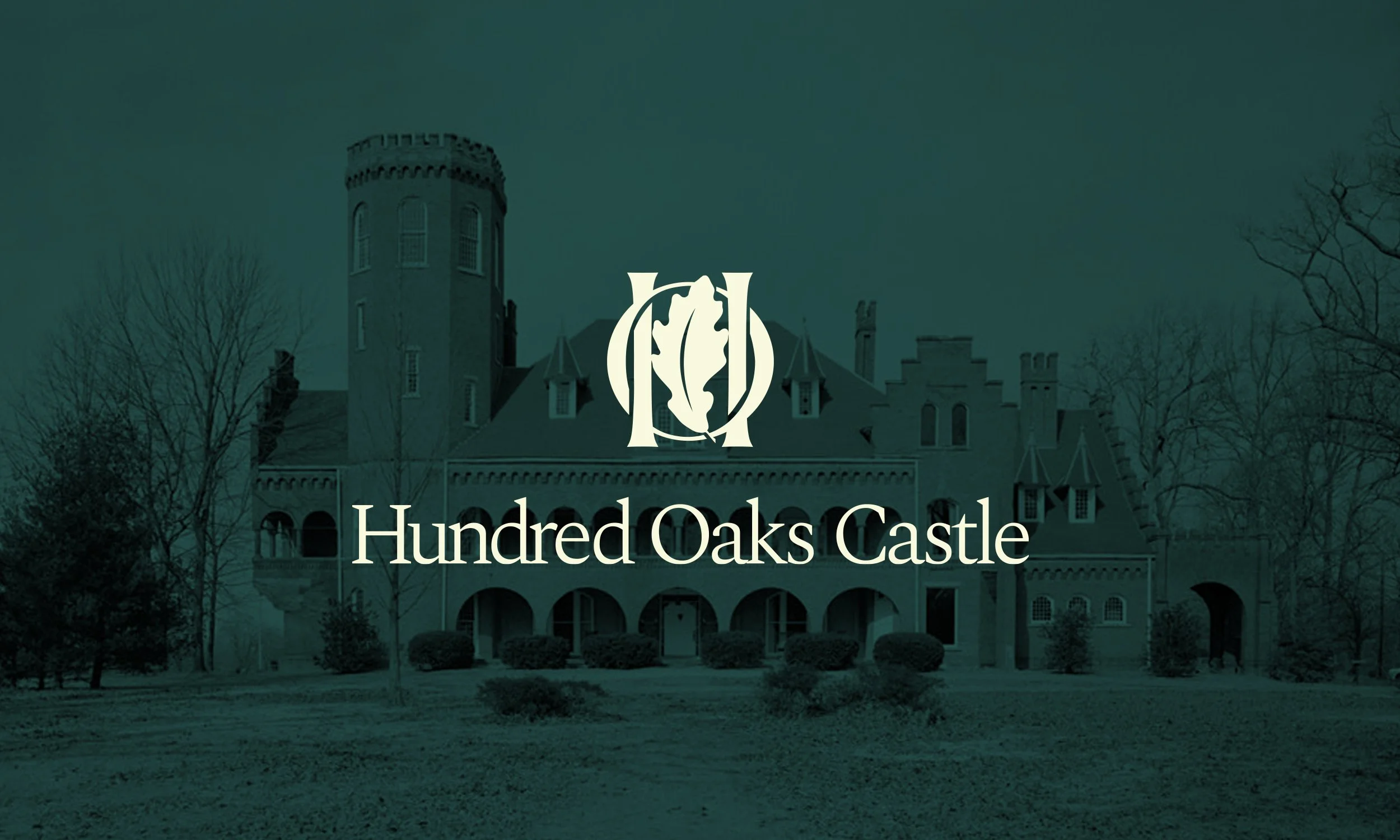
Here's what I made: A monogram-style logo combining the letters H, O, and C (Hundred Oaks Castle) with an oak leaf integrated into the circular design. The mark sits above elegant serif typography spelling out the full name. The whole thing is black on white—classic, timeless, sophisticated. The monogram has symmetry and weight. The oak leaf connects directly to the name and grounds the design in nature, which reflects the property's actual setting. The typography feels formal without being stuffy. And the overall mark has the kind of refinement you'd expect from a historic estate, but with a contemporary clarity that works across digital and print applications. This is the kind of logo that would look equally good embossed on a wedding invitation, printed on a website header, or carved into a wooden sign at the entrance to the property. And here's the important part: I did this as a design exercise, not because they hired me. This is spec work in the best sense—not free work for a client, but creative practice that builds your skills and your portfolio while showing real-world problem-solving.
Why Redesign Historic Venue Logos?
Let me tell you why this particular creative brief is so valuable, both as a design exercise and as a potential lead generation tool.
First, it's real-world design thinking. You're not designing for a made-up company or a fictional brand. You're working with a real property that has real history, real customers, and real competitive positioning. That forces you to think strategically, not just aesthetically. You have to ask: Who stays here? Who gets married here? What feeling are they looking for? What makes this castle different from every other event venue in the region?
Second, it builds portfolio work that demonstrates value. A logo redesign for a historic venue shows potential clients that you understand how to balance tradition with modernity, how to communicate elegance without feeling dated, and how to create visual identities that attract the right audience. Those are exactly the skills boutique hotels, bed & breakfasts, event venues, and hospitality brands are looking for when they're ready to rebrand.
Third, it's excellent cold outreach practice. If you design a killer logo for a venue and share it thoughtfully (more on this later), you're not just posting portfolio work—you're opening a conversation. Maybe the venue loves it and wants to talk about actually implementing it. Maybe they refer you to another property owner. Maybe someone else in the hospitality industry sees it and reaches out. You're creating opportunities, not just pretty pictures.
Fourth, there's a built-in audience. Historic venues have customers, followers, communities. When you tag them (respectfully) in a redesign, you're tapping into their network. People who love that venue will engage with thoughtful work that honors the property. That visibility is valuable.
How to Choose Your Venue
Your first step is picking which property you want to redesign. And this matters more than you might think, because not all venues are created equal when it comes to design potential. Here's what to look for:
Look for properties with strong architecture or history. The venue itself should be visually interesting and have a clear identity. Castles, chateaus, historic mansions, vineyards, restored barns, estates with distinctive features. You want a property that has something to say visually.
Look for venues with weak current branding. This isn't about tearing anyone down—it's about finding opportunities. If the logo is generic, outdated, or doesn't reflect the quality of the property, that's your opening. You can show dramatic before-and-after contrast that demonstrates your value as a designer.
Look for properties in regions you care about or want to work in. If you're based in the South and want hospitality clients in that market, choose Southern venues. If you're in wine country and want to work with vineyards, choose a winery. Strategic portfolio work targets the clients you actually want.
Look for venues that are active on social media. You want properties that engage with their audience, because that increases the chance your redesign will be seen and shared. Check their Instagram, their Facebook, their website. Are they posting regularly? Do they respond to comments? That's a good sign.
Some examples to get you thinking:
Castle wedding venues (like Hundred Oaks Castle)
Historic bed & breakfasts
Vineyard estates
Restored plantation homes (with sensitivity to history)
Boutique hotels in old buildings
Event barns on working farms
Chateaus and manor houses
Pick one that genuinely interests you. You're going to spend time with this property—researching it, thinking about its story, designing for its audience—so choose something you'd actually be excited to work on.
The Redesign Process: From Research to Refined Mark
Alright, let's walk through how to actually approach this redesign in a way that's strategic, not just decorative.
Step 1: Research the property thoroughly.
Go to their website. Read their About page. Look at their photo galleries. Check their social media. Read guest reviews on Google, TripAdvisor, wedding planning sites. You're trying to understand:
What's the actual history of this place?
Who are their customers? (Weddings? Corporate retreats? Weekend getaways?)
What's their current positioning? (Luxury? Rustic elegance? Historic charm?)
What makes them different from competitors?
For Hundred Oaks Castle, I learned it was built in the 1890s, it's Gothic Revival architecture, it's surrounded by oak trees (hence the name), and it primarily serves as a wedding venue. That gave me everything I needed to know.
Step 2: Analyze their current logo (if they have one).
What's working? What's not? Be specific. Is it the typography? The icon? The color palette? The overall composition? Don't just say "it's bad"—articulate why it's not serving the property well. This is how you build your case study later. "The previous logo used overly decorative script that reduced legibility at small sizes and felt dated rather than timeless."
Step 3: Define your design direction.
Based on your research, decide what the new logo needs to communicate. Write it down. For Hundred Oaks Castle, my direction was: elegant, historic, rooted in nature, timeless, wedding-appropriate, refined but not fussy. That direction ruled out certain approaches immediately. No rustic hand-drawn style. No modern sans-serif minimalism. No overly ornate Victorian flourishes. It pointed me toward classic monogram design with natural elements.
Step 4: Design multiple concepts.
Don't settle for your first idea. Explore at least three different directions:
A monogram/crest approach
A wordmark with elegant typography
An icon + wordmark combination
For each one, ask: Does this feel like it belongs to this specific property? Could this logo work for any other venue, or is it distinctly theirs?
Step 5: Refine your strongest concept.
Once you've identified which direction feels right, refine it ruthlessly. Adjust the spacing. Perfect the curves. Test it at different sizes. Make sure it works in black and white before you add color. Ensure it's legible at favicon size and impressive at billboard size.
Step 6: Present it professionally.
Create a simple mockup showing the logo in context. On a website header. On a business card. On a sign. On wedding stationery. This isn't just about the logo existing in a vacuum—it's about showing how it works for the business.
The Business Case: Why Venues Need This
Let me shift gears for a second and talk directly to the venue owners, innkeepers, and hospitality professionals who might be reading this. If you run a historic property—a castle, a chateau, a bed & breakfast, an event venue—and your logo hasn't been updated in years (or ever), here's what you need to know: Your visual identity is often the first impression potential guests have of your property. Before they see photos of your rooms, before they read reviews, before they visit in person, they see your logo on Google search results, on wedding vendor lists, on Instagram, on your website. And if that logo looks dated, generic, or doesn't match the quality of the experience you provide, you're losing bookings to competitors who've invested in professional branding.
A strong logo for a historic venue should:
Communicate your positioning instantly. Are you luxury? Rustic charm? Historic elegance? The logo should telegraph that immediately.
Differentiate you from competitors. If your logo could work for any hotel or event space, it's not doing its job.
Appeal to your ideal customer. A castle wedding venue needs to attract couples planning elegant celebrations, not backyard BBQs. Your visual identity filters for the right audience.
Work across all touchpoints. Website, social media, signage, print materials, embroidery on linens—your logo shows up everywhere, and it needs to perform in all those contexts.
Age well. Trendy design looks dated in five years. Classic, thoughtful design works for decades.
If you're reading this and thinking, "Our logo probably needs work," you're right. And the designer who just redesigned your property as a creative exercise? That's someone who's already invested time in understanding your brand. That's worth a conversation.
How to Share Your Redesign (Without Being Weird)
Okay, so you've designed a beautiful new logo for a real venue. Now what?
Do this:
Post it on your portfolio site and social media as a personal project/design exercise
Tag the venue respectfully with language like: "I was inspired by [Venue Name] and created this logo concept as a design exercise. Would love to hear what you think!"
Frame it as a love letter to the property, not criticism of their current branding
Include process notes showing your research and strategic thinking
Make it clear you're not expecting anything—this was practice, but you're open to conversations
Don't do this:
Don't present it as if they hired you (that's misleading)
Don't trash their current logo publicly (that's unprofessional)
Don't demand they use your design (that's entitled)
Don't spam them repeatedly if they don't respond (that's annoying)
The goal is to demonstrate value, open doors, and build relationships—not to pressure anyone or misrepresent your work.
Your Assignment
Here it is. Your Monday prompt.
Choose a real castle, chateau, or historic venue. Research it thoroughly. Redesign their logo. Present it professionally.
Make it elegant. Make it strategic. Make it better than what they currently have. And when you're done, share it—both as portfolio work and as a potential conversation starter with the property itself. This isn't just a creative exercise. It's practice for the kind of branding work that builds businesses and brings in clients who value design thinking, not just decoration. Now go find your castle. And give it the visual identity it deserves.
A Note to Venue Owners
If you're a property owner who landed here because someone redesigned your logo and tagged you—first, that's flattering. Someone cared enough about your property to invest their time and creativity into reimagining your brand. Second, if you love what they created, reach out. The best client relationships often start with someone demonstrating they already understand your vision before you ever hire them.
And if you're thinking your venue could use a rebrand—you're probably right. Let's talk about what that could look like for your property. My inbox is open.